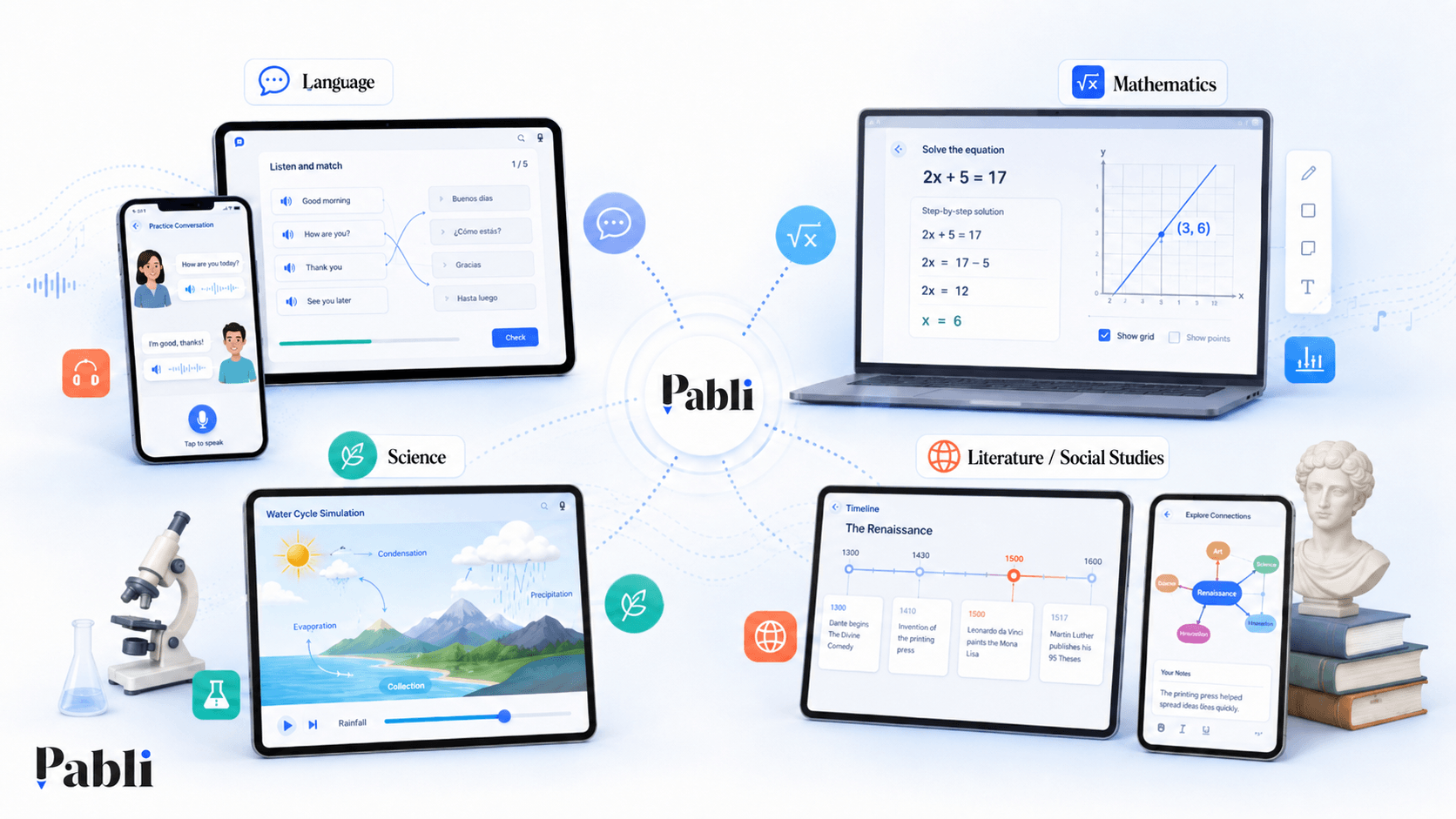
All educational content can be digitised, but it should not all be digitised in the same way. Language learning may rely heavily on audio, dialogue and practice, while mathematics benefits from step-by-step solutions, science from simulations and social sciences from timelines, maps and concept relationships.
One of the most common mistakes in educational content production is applying the same activity formats to every subject.
A content platform may provide a large library of question and game templates, but the number of templates does not determine the quality of the learning experience.
The essential question is not:
“What interactions can we add?”
It is:
“What kind of thinking and learning behaviour should this content encourage?”
One interaction template cannot serve every subject
A drag-and-drop activity can work well in a language lesson where learners match words to images.
The same format may be too superficial for interpreting a literary text.
A simulation can be highly effective for exploring a physics experiment. For analysing the causes of a historical event, however, a timeline, source comparison or decision-making scenario may be more suitable.
As the subject changes, so do:
- The actions expected from learners
- The type of feedback they need
- The role of media
- The role of the teacher
- The appropriate assessment approach
Digital content design should therefore begin with the learning purpose—not with the available activity template.
How should language learning content be digitised?
Language textbooks are naturally suited to interactive formats because language learning involves multiple skills: reading, writing, listening and speaking.
In printed materials, these elements are often distributed across different resources. The text appears in the book, the audio is hosted elsewhere and additional practice may be provided on a separate platform.
A digital environment can bring them together within a single learning experience.
Suitable digital experiences for language learning
- Listening activities
- Word-to-image matching
- Sentence sequencing
- Dialogue completion
- Fill-in-the-gap exercises
- Pronunciation audio
- Role-play scenarios
- Video-based questions
- Immediate explanatory feedback
- Vocabulary flashcards
- Read-aloud texts
- Speaking models
Interactive whiteboard example
A teacher can display a dialogue on the board.
The class first listens to the audio. Learners then arrange the dialogue lines into the correct order. Finally, students take roles and perform the conversation.
The same source material can also become an individual listening activity, vocabulary exercise or microlearning lesson.
The strength of digitisation in language learning lies in bringing text, audio, visuals and practice into one connected experience.
How should mathematics content be digitised?
Mathematics digitisation is often limited to displaying questions on screen.
Yet the greatest opportunity lies in making the thinking and solution process visible.
Showing only the correct answer does not help learners understand how the solution was constructed.
Digital content can reveal each stage of the solution, explain the rules being used and highlight the points where learners are most likely to make mistakes.
Suitable digital experiences for mathematics
- Step-by-step solutions
- Progressive hints
- Layered formula explanations
- Interactive graphs and functions
- Geometry tools
- Adjustable variables
- Solution-sequencing activities
- Error analysis
- Alternative methods
- Whole-class problem-solving
- Immediate result comparison
Example
In a printed book, a function graph is fixed.
In an interactive environment, learners can change the coefficients and immediately observe how the graph responds.
Instead of simply examining a single example, learners explore the relationship between the variables.
In mathematics, interaction should make mathematical reasoning visible rather than simply turning questions into games.
How should science content be digitised?
Science includes processes that are difficult to observe directly, happen too quickly or slowly, or are impractical to reproduce in a classroom.
Digital environments can make these processes accessible.
Suitable digital experiences for science
- Virtual experiments
- Simulations
- Layered scientific visuals
- Variable control
- Prediction and outcome comparison
- Process animations
- Interactive laboratory tools
- Data tables and graphs
- Experiment sequencing
- Safe practice scenarios
Example
In an electrical circuit simulation, learners can change the number of batteries, resistors and bulbs.
They can observe how each change affects the circuit.
The teacher might first ask the class to predict what will happen, then use the simulation to test the prediction.
This approach supports exploration and comparison rather than memorisation of a single correct answer.
How should social sciences content be digitised?
History, geography, philosophy and citizenship content is often heavily text- and image-based.
This can lead teams to assume that digitisation simply means adding video.
However, explanation-led subjects can support highly effective interactive experiences.
Suitable digital experiences for social sciences
- Timelines
- Interactive maps
- Cause-and-effect diagrams
- Concept maps
- Historical source comparisons
- Decision scenarios
- People and event cards
- Visual analysis activities
- Discussion prompts
- Viewpoint classification
- Regional data comparisons
Example
A history unit can move beyond listing events chronologically.
Learners can examine political, social and economic causes separately, compare sources and explore how different factors contributed to the same event.
In these subjects, interaction is valuable not only for breaking information into smaller pieces, but also for making relationships visible.
How should literature and language arts content be digitised?
Making literature interactive does not mean dividing a text into small sections and adding a question after every paragraph.
Literary works are multi-layered. They involve language, context, narrative perspective, historical period, characters and themes.
Digital experiences should support deeper access to the text rather than compete with it.
Suitable digital experiences for literature
- Annotated texts
- Vocabulary and concept layers
- Author and historical-context links
- Character relationship maps
- Theme comparisons
- Connections between texts
- Audio performances of poems and passages
- Timelines
- Quotation classification
- Interpretation and discussion questions
- Narrative perspective comparisons
Example
In a poem, learners can explore the imagery, compare interpretations and listen to a performed reading instead of merely identifying literary devices.
In a novel, a character map can show how relationships change as the story develops.
Digital design does not need to simplify the text. It can reveal layers that are difficult to present on a printed page.
How should question banks be digitised?
Digitising a question bank can offer far more than displaying questions on screen.
In a printed book, learners answer a question, check the answer key and continue.
In a digital environment, the system can track performance, identify recurring errors and guide future practice.
Useful features for digital question banks
- Filtering by topic
- Difficulty-based practice
- Step-by-step solutions
- Optional hints
- Explanations for incorrect answers
- Similar-question recommendations
- Question-level performance tracking
- Timed practice tests
- Personal revision lists
- Teacher-created assessments
- Automatic redirection to weak topics
The primary value of a digital question bank is not automatic scoring alone.
It is the ability to reveal where the learner is struggling: the topic, the question format or the stage of reasoning.
How should vocational and corporate training be digitised?
In vocational and workplace training, the objective is often not simply to remember information. It is to apply the correct behaviour in a real situation.
For this reason, digital learning should be designed around authentic scenarios.
Suitable digital experiences for vocational learning
- Scenario-based decision-making
- Workflow simulations
- Safety-procedure sequencing
- Error-detection activities
- Interactive equipment diagrams
- Checklists
- Video-based performance analysis
- Case studies
- Role-specific content
- Completion and certification assessments
In workplace safety training, for example, employees should not only read a list of rules.
They can examine different environments, identify risks and choose the correct response.
When they make the wrong decision, the content can explain the possible consequences rather than simply marking the answer as incorrect.
Can explanation-led content still be interactive?
Yes. It does not need to be turned into a game.
Explanation-led content can be improved digitally by:
- Dividing long texts into meaningful sections
- Highlighting key concepts
- Making additional explanations optional
- Presenting comparisons in structured tables
- Visualising processes
- Adding layers to diagrams
- Including short reflection questions
- Connecting concepts to real-world examples
- Providing teacher-only explanation areas
- Creating conceptual summaries
Content does not need constant movement to feel digital.
A well-structured explanation, an interactive comparison or an expandable information layer can create a meaningful digital experience.
How do you choose the right interaction?
Five questions can guide the decision.
1. What should the learner understand?
Are they expected to remember, relate, apply, analyse or evaluate?
2. What should the learner do?
Should they select, sequence, compare, create, test or interpret?
3. What feedback would be useful?
Is the correct answer enough, or does the learner need explanation and guidance?
4. Where will the content be used?
Interactive whiteboards, mobile devices, web platforms and LMS environments require different design decisions.
5. What is the teacher’s role?
Will the teacher control the content, or will the learner complete it independently?
Once these questions are answered, the most suitable interaction becomes much clearer.
Why does Pabli use a modular approach?
Different subjects and learning objectives require different digital experiences. A single fixed template cannot address them all.
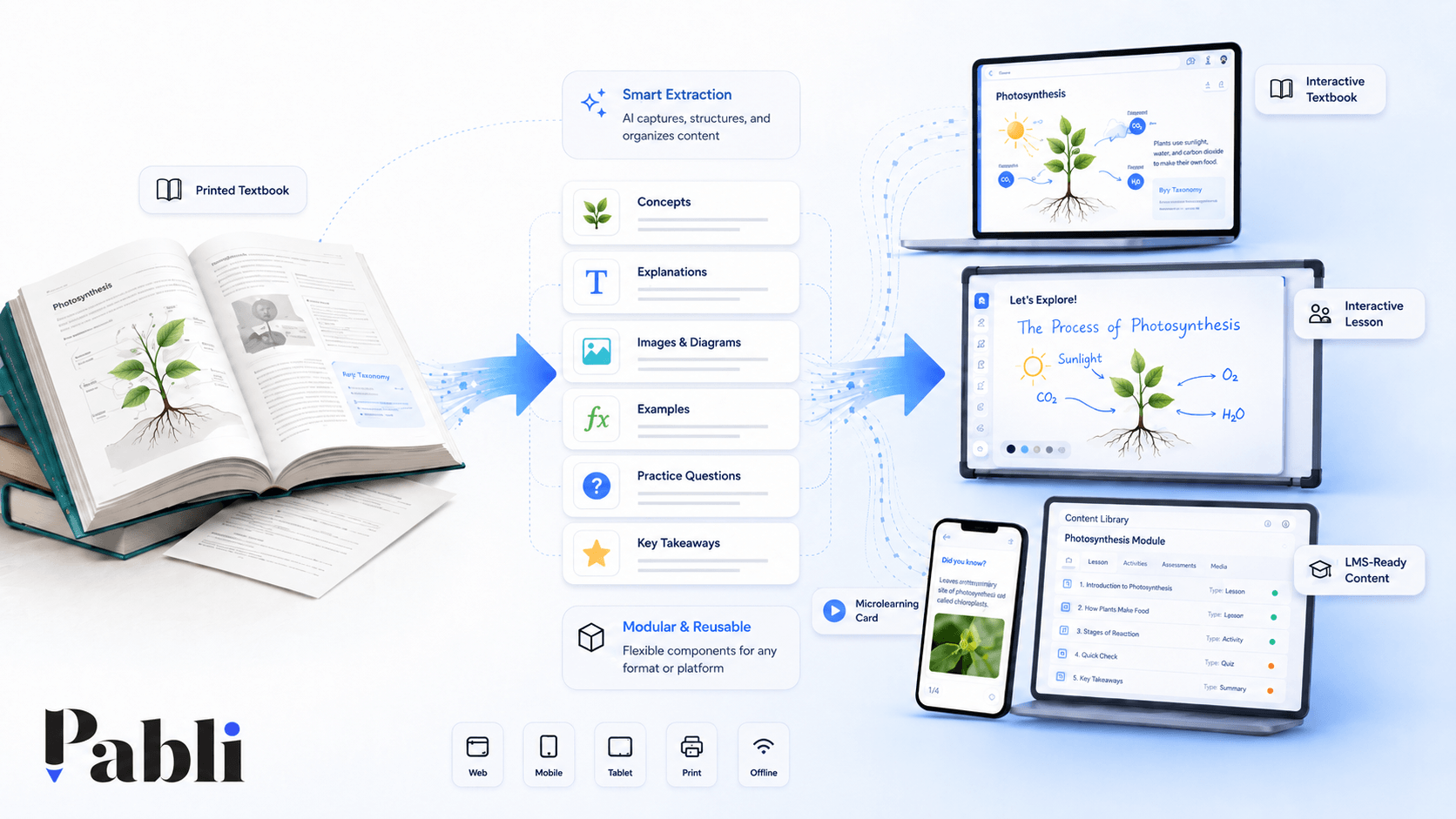
Pabli’s modular structure allows text, images, audio, video, questions, sequencing, matching, assessment, games and simulations to be combined according to the needs of the content.
A language textbook and a mathematics textbook are therefore not forced into the same format.
Each resource can be structured according to its own learning goals.
The modules can also be reused across different lessons and products, making content production more scalable for publishers and education providers.
Conclusion
Every type of educational content can be digitised, but the right approach depends on the subject and learning objective.
Language learning benefits from audio and practice. Mathematics benefits from visible reasoning. Science benefits from simulation. Social sciences benefit from relationships and comparison. Literature benefits from deeper access to the text. Vocational learning benefits from realistic decision-making.
Effective digital content is designed around learning—not around whichever technology happens to be available.
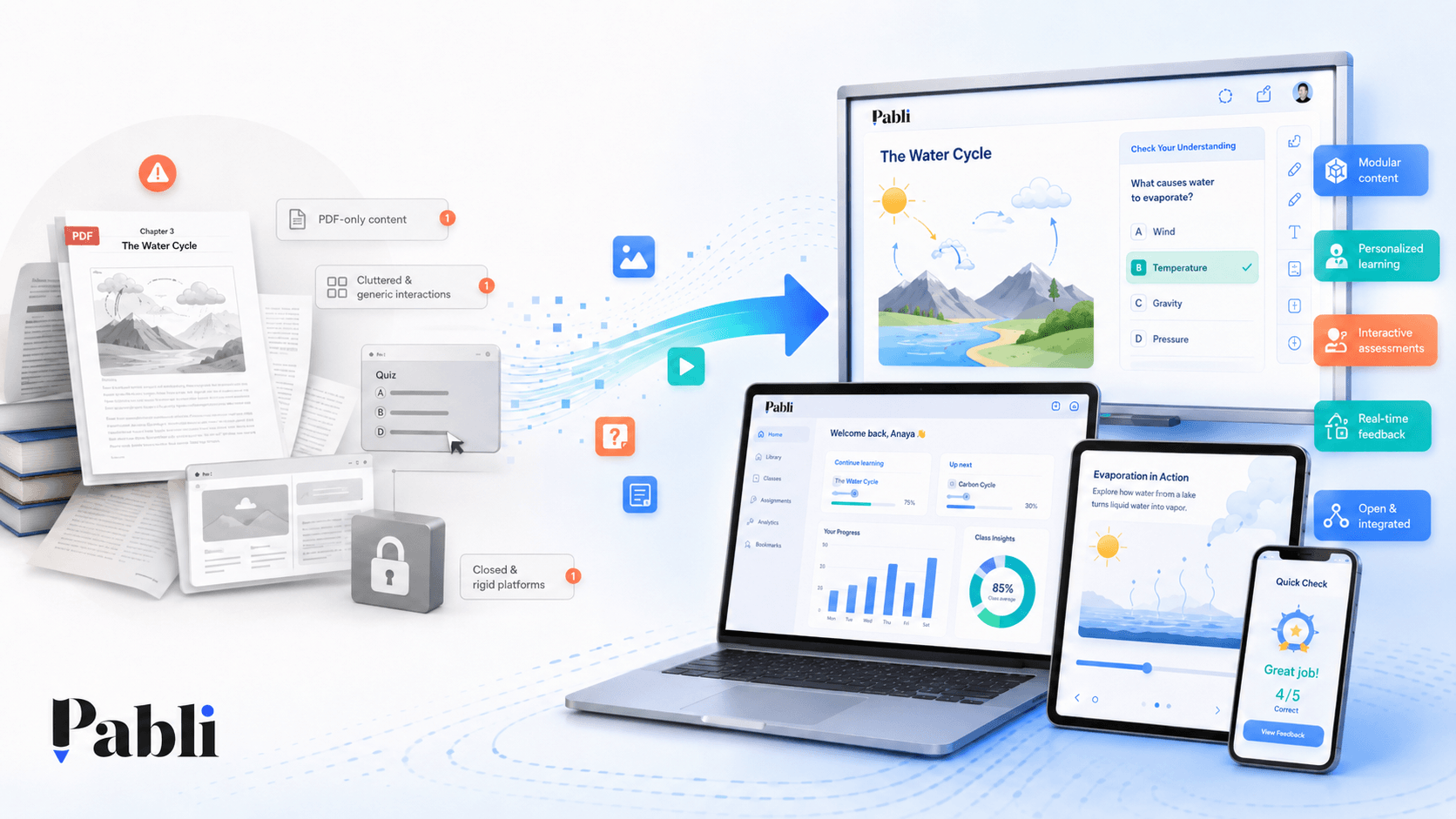
Pabli helps organisations create interactive experiences that reflect the specific needs of each subject and publication type, rather than forcing every piece of content into the same template.
Frequently Asked Questions
Should gamification be used in every subject?
No. Gamification should be used when it supports a clear learning or motivation objective. Adding points, competition or games to every resource does not automatically improve learning.
Can explanation-heavy textbooks become interactive?
Yes. Concept maps, layered visuals, timelines, comparisons, examples and reflection questions can create an effective digital experience without turning the lesson into a game.
What interactions work well in mathematics?
Step-by-step solutions, graph simulations, geometry tools, hints, error analysis and solution sequencing can all support mathematical learning.
Can the same activity be used across different subjects?
Technically, yes. However, its instructions, feedback and learning purpose should be adapted to the subject.
Can Pabli support different types of publications?
Pabli’s modular content approach can be adapted to textbooks, question banks, language-learning resources, vocational training materials and corporate learning documents.